
KCSE History & Government Paper 1 (2025) – Free Past Questions and Revision Guide


1.)Introduction to KCSE History & Government
2.)Why Paper 1 Matters
4.)Section B: Important Essays and Analysis
6.)Tips to Answer KCSE History Questions
7.)Download 2025 Paper 1 PDF
KCSE History and Government is not just about memorizing dates and names. It is a subject that rewards understanding, confidence, and smart answering techniques. Many students fail not because they do not know the content, but because they panic, rush, or fail to interpret the questions correctly.

KCSE History and Government is a core subject in Kenya’s secondary school curriculum, aimed at helping students understand the historical, political, social, and economic development of Kenya and the wider world. The subject equips learners with knowledge about pre-colonial, colonial, and post-independence periods, fostering analytical and critical thinking skills.
Want Physical revision papers Visit Our Cyber

Services:
📄 Bulk Printing, Photocopy & Scanning
🧾 KRA Returns, PIN & Tax Services
🚗 NTSA Services (DL, Smart DL, TIMS)
🏢 eCitizen Services (Certificates, Applications)
📑 CV Writing & Document Formatting
📊 Online Applications & Form Filling
It covers governance systems, civic responsibilities, human rights, and national development. Through the KCSE examination, students demonstrate their ability to interpret historical events, evaluate sources of information, and discuss the impact of historical and governmental processes on contemporary society, preparing them for higher education and active citizenship.
Want To Learn More on Geography Paper 1 Start Here >>>
Performing well in Paper 1 demonstrates mastery of essential concepts, boosts confidence, and sets the stage for higher scores in the entire KCSE History and Government exam, making it a vital component of exam preparation.
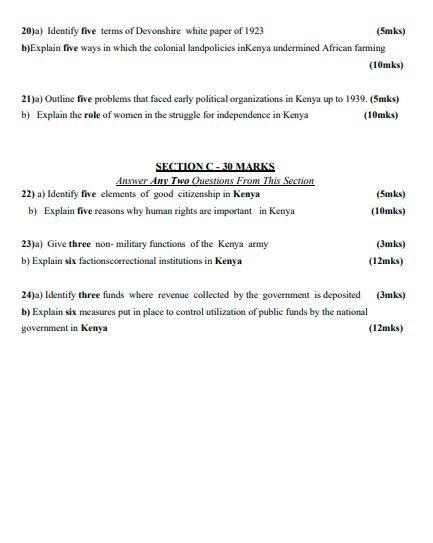
Section A – Suggested Answers (1–17)
Give two electronic sources of information in the study of history and government.
Internet websites
Online archives/databases (e.g., Kenya National Archives digital collections)
Give two economic reasons for the migration of Luo into Kenya by the 19th Century.
Search for fertile land for agriculture
Access to fishing and trading opportunities along Lake Victoria
Identify the center of power in a decentralized government of pre-colonial Kenyan societies.
Council of elders
Apart from the Mijikenda, name two coastal Bantu communities.
Digo
Giriama
Identify the main political contribution of Christian missionaries in colonial Kenya.
Promotion of Western education and literacy
Give a reason why mob justice is forbidden in Kenya.
It violates the rule of law and human rights
Identify two circumstances under which a person’s right to own property may be denied.
If the property is acquired through illegal means
If it threatens public interest or security
Give two trade items from the interior during long-distance trade in Kenya in the 16th Century.
Ivory
Gold
State the Nandi leader who resisted British rule in Kenya.
Koitalel Arap Samoei
Name the type of constitution used in Kenya.
Written constitution
State the main duty of the Governor during the British colonial rule in Kenya.
Implement colonial policies and maintain law and order
Identify two Kenyan communities who gave mixed reactions to colonial rule.
Kikuyu
Luo
Give two reasons why corruption is discouraged in Kenya.
It undermines development
It erodes public trust in government
Define the term “Devolution.”
The transfer of power and resources from the national government to local or county governments
State the education commission in Kenya which recommended the 8-4-4 system of education.
Mackay Commission (also called the Kenya Education Commission, 1981)
Name the ex-official member of the Senate.
Speaker of the Senate (ex-officio member)
Identify two pillars of Nyayoism.
Peace
Love
📚 Help Us Create Better KCSE Revision Content for Students Across Kenya!
Are you a KCSE student preparing forexams? We want to understand the topics students struggle with most so we can create better revision materials, model answers, prediction questions, and free study guides that actually help you score higher.
Whether you are in a public school, private school, national school, extra-county, county, or day school, your feedback matters. By filling this short Google Form, you will help us understand:
Which KCSE History topics students struggle with most
Whether students prefer notes, questions & answers, or prediction papers
Differences between public and private school revision experiences
Which subjects need more free revision resources
How students prepare for KCSE exams across Kenya
🎯 Your responses will help build one of the biggest KCSE student revision databases in Kenya while helping us create smarter revision content for future candidates.
👉 Fill the Google Form Below and Help Shape Better KCSE Revision Resources for Students Across Kenya!
Question 18
a) Identify three Cushitic communities in Kenya.
Somali
Rendille
Borana
Introduction of pastoralism in northern and eastern Kenya.
Spread of Cushitic languages in the region.
Establishment of trade routes with other communities.
Intermarriage with other ethnic groups, leading to cultural assimilation.
Conflicts over grazing land with Nilotic and Bantu communities.
Development of social and political structures among Cushitic communities.
Question 19
a) Identify five features of the coastal city-states during the pre-colonial period.
Located along the Indian Ocean coast.
Engaged in long-distance trade with Arabs, Persians, and Indians.
Practiced Islam and had Islamic cultural influence.
Had organized city councils for governance.
Produced goods like ivory, mangrove poles, and spices for trade.
b) Explain five consequences of the Indian Ocean trade to the people of East Africa.
Growth of wealthy merchant classes in coastal towns.
Spread of Islam and Arab culture.
Development of Swahili language and culture.
Increase in the number of slaves due to the slave trade.
Introduction of new goods, ideas, and technologies from foreign traders.
Question 20
Africans should have more participation in governance.
Europeans would continue to have political influence.
Kikuyu Land Commission to address land grievances.
Protection of African land rights.
Recognition of the interests of all races in Kenya.
b) Explain five ways in which the colonial land policies in Kenya undermined African farming.
Confiscation of fertile land for European settlers.
Creation of Native Reserves with poor soils.
Restrictions on African farming in White Highlands.
High taxes forcing Africans to work on European farms instead of their own.
Introduction of cash crop farming at the expense of subsistence farming.
Section C: Citizenship and Government Topics
Question 22
a) Identify three functions of political parties in Kenya.
Mobilizing citizens to participate in politics.
Providing leadership and candidates for elections.
Educating the public on government policies and national issues.
b) Explain six factors that promote national unity in Kenya.
The Constitution promotes equality of all citizens regardless of tribe or religion.
National schools encourage interaction among students from different communities.
Kiswahili acts as a national language that unites Kenyans.
Intermarriages among communities reduce tribal divisions.
National holidays and events promote patriotism and togetherness.
Devolution ensures equitable sharing of resources across counties.
Question 23
a) Identify five functions of the Independent Electoral and Boundaries Commission (IEBC).
Conducting and supervising elections and referenda.
Registering voters and maintaining the voters’ register.
Delimiting electoral boundaries.
Regulating political party nominations during elections.
Voter education and ensuring free and fair elections.
b) Explain five principles of democracy practiced in Kenya.
Citizens have the right to vote and choose leaders freely.
The rule of law ensures everyone is equal before the law.
Separation of powers prevents abuse of authority.
Freedom of expression allows citizens to air their opinions openly.
Regular elections ensure leaders remain accountable to the people.
Question 24
a) Identify three arms of government in Kenya.
Legislature
Executive
Judiciary
b) Explain six functions of the Judiciary in Kenya.
Interpreting the Constitution and laws of Kenya.
Settling disputes between individuals and organizations.
Protecting the rights and freedoms of citizens.
Administering justice fairly and independently.
Hearing and determining election petitions.
Checking abuse of power by the Executive and Legislature.
Tips to Answer KCSE History Questions
Before answering any question, carefully read and underline key words such as identify, explain, state, describe, or give reasons. These command words determine the type of answer expected and the marks awarded.
Always begin with the easiest questions to build confidence and save time for difficult sections later. In essay questions, organize your points clearly and support them with facts, examples, and explanations. Avoid one-word answers where explanations are required. Remember that neat handwriting and proper paragraphing make your work easier to read and can create a positive impression on the examiner.
Most importantly, believe in yourself. Thousands of students fear History because they think it is too wide, yet many top performers simply master revision habits and past papers. Every topic you revise today increases your confidence tomorrow. Do not wait for the last week before exams. Consistent daily revision, group discussions, and practicing past KCSE papers can transform an average student into an A student. Your KCSE result can open doors to university, scholarships, and future careers, so stay disciplined, focused, and never give up on yourself.
Download 2025 Paper 1 PDF
Study Strategies for KCSE History
Create a Revision Timetable
Allocate specific time daily for History and Government revision instead of cramming near exams. Consistency improves memory retention.
Master the KCSE Syllabus
Understand all topics covered in Form 1 to Form 4. Focus on frequently tested areas such as government structure, nationalism, and Kenyan communities.
Practice KCSE past papers regularly to understand question patterns, marking schemes, and examiner expectations.
Learn Command Words
Understand terms like state, explain, identify, describe, and discuss since they determine how answers should be written.
Summarize Notes in Point Form
Convert long notes into short revision points, timelines, and flashcards for easier memorization.
Study Historical Events Chronologically
Arranging events by time helps students understand causes, effects, and relationships between events.
Practice Essay Writing Skills
Learn how to structure introductions, body paragraphs, and conclusions clearly for Section B and C essays.
Revise Using Maps and Charts
Visual learning helps students remember migration routes, trade networks, and political structures more effectively.
Discuss Topics with Friends
Group discussions improve understanding and help students learn different answering techniques.
Teach Others What You Learn
Explaining a topic to another student strengthens understanding and memory retention.
Focus on Weak Areas Early
Identify difficult topics and spend more time improving them instead of avoiding them.
Read Examiner Reports and Marking Schemes
These reports reveal common mistakes students make and what examiners expect in high-scoring answers.
Practice Time Management
During revision, answer questions within the allocated exam time to improve speed and confidence.
Use Mnemonics and Memory Tricks
Short memory aids help students remember dates, commissions, leaders, and important events.
Avoid Last-Minute Cramming
Proper rest and gradual revision improve concentration better than overnight reading.
📚 Help Us Create Better KCSE Revision Content for Students Across Kenya!
Are you a KCSE student preparing forexams? We want to understand the topics students struggle with most so we can create better revision materials, model answers, prediction questions, and free study guides that actually help you score higher.
Whether you are in a public school, private school, national school, extra-county, county, or day school, your feedback matters. By filling this short Google Form, you will help us understand:
Which KCSE History topics students struggle with most
Whether students prefer notes, questions & answers, or prediction papers
Differences between public and private school revision experiences
Which subjects need more free revision resources
How students prepare for KCSE exams across Kenya
🎯 Your responses will help build one of the biggest KCSE student revision databases in Kenya while helping us create smarter revision content for future candidates.
👉 Fill the Google Form Below and Help Shape Better KCSE Revision Resources for Students Across Kenya!
1. What is KCSE History and Government?
KCSE History and Government is a secondary school subject in Kenya that teaches students about historical events, governance, leadership, citizenship, and political development.
2. How many papers are tested in KCSE History and Government?
Students usually sit for two papers: Paper 1 and Paper 2, each covering different sections of the syllabus.
3. What topics are mostly tested in Paper 1?
Paper 1 mainly focuses on Kenyan history, government structure, citizenship, constitutional development, and political systems.
4. How can I score highly in KCSE History?
Students can improve performance through consistent revision, practicing past papers, understanding command words, and mastering essay writing techniques.
5. Why are past papers important in KCSE revision?
Past papers help students understand question patterns, improve time management, and familiarize themselves with examiner expectations.
6. What is the difference between “state” and “explain” in History questions?
“State” requires short direct answers, while “explain” requires detailed points with supporting information and examples.
7. How should students answer essay questions in KCSE History?
Essay answers should have clear points, explanations, examples, and proper paragraph structure to maximize marks.
📚 Help Us Create Better KCSE Revision Content for Students Across Kenya!
Are you a KCSE student preparing forexams? We want to understand the topics students struggle with most so we can create better revision materials, model answers, prediction questions, and free study guides that actually help you score higher.
Whether you are in a public school, private school, national school, extra-county, county, or day school, your feedback matters. By filling this short Google Form, you will help us understand:
Which KCSE History topics students struggle with most
Whether students prefer notes, questions & answers, or prediction papers
Differences between public and private school revision experiences
Which subjects need more free revision resources
How students prepare for KCSE exams across Kenya
🎯 Your responses will help build one of the biggest KCSE student revision databases in Kenya while helping us create smarter revision content for future candidates.
👉 Fill the Google Form Below and Help Shape Better KCSE Revision Resources for Students Across Kenya!
8. Can I revise KCSE History using short notes?
Yes. Short notes, flashcards, and summaries make revision easier and help students remember key facts quickly.
9. How much time should students spend revising History daily?
Even 30 minutes to 1 hour of focused daily revision can greatly improve understanding and confidence before exams.
No. With discipline, consistent revision, and regular practice of past papers, many students perform well in History and Government.
Want Physical revision papers Visit Our Cyber


This is a valuable resource for students preparing for the KCSE History and Government exam. Practicing past papers is a great way to strengthen understanding of key topics, improve time management, and build confidence before the exam. I appreciate it and fnaf