
Coffee Farming in Kenya (2026 Guide): Cost, Profit, Varieties, Yield & Market Trends


1.)Introduction to Coffee Farming in Kenya
2.)Coffee Growing Regions in Kenya
3.)Coffee Varieties in Kenya Explained
5.)Coffee Farming Costs in Kenya (Per Acre Breakdown)
6.)Coffee Yield Per Acre in Kenya
8.)Coffee Processing Methods in Kenya
9.)Coffee Marketing and Selling in Kenya
10.)Challenges Facing Coffee Farmers in Kenya
12.)Frequently Asked Questions (FAQ)
Introduction to Coffee Farming in Kenya
Did you know? Kenya’s coffee production dropped from over 128,000 metric tonnes in the 1980s to just about 50,000 metric tonnes today, creating a massive gap — and opportunity — for new farmers and investors.

Coffee farming in Kenya is one of the most important agricultural activities, supporting over 800,000 smallholder farmers and thousands of estates across the country. It is grown mainly in highland regions with fertile volcanic soils and favorable climates, including counties such as Nyeri, Kiambu, Kirinyaga, Embu, and Meru. Kenya produces predominantly Arabica coffee (over 99%), which is globally recognized for its high quality and premium prices.
Year 1–2 → No production
Year 3 → First harvest
Year 4–5 → Full production
Year 5+ → Peak productivity
Coffee trees remain productive for 20–30 years

Coffee plant with ripe orange berries on branches by Coffee Farmers Kenya Ltd
According to Kenya’s national coffee development strategy Kenya has over 800,000 smallholder coffee farmers, making it one of the most important cash crops in the country.
Despite its strong reputation, the sector has experienced a decline in production over the years, creating a major opportunity for revival.
Buy or Sell Coffee in Kenya
Looking for coffee buyers?
Want to source high-quality Kenyan coffee?
👉 Connect with trusted farmers and suppliers
🔘 Submit your request🔘 List your coffee
With increasing global demand, improved varieties like Ruiru 11 and Batian, and government-backed strategies to boost productivity and farmer earnings, coffee farming in Kenya remains a high-value, long-term investment for both small-scale farmers and agribusiness investors.
According to the Kenya Coffee Sustainability Manual developed by the Kenya Coffee Platform, proper nursery management, soil preparation, and pruning are the most critical factors determining long-term coffee yield.
Coffee in Kenya is mainly grown in high-altitude regions between 1,200–2,100 meters above sea level, where cool temperatures (15–26°C), rich volcanic soils, and reliable rainfall support quality production.

Ernest Murangiri Mbiuki holds a Ruiru 11 seedling in a nursery
The key coffee-growing zones include Central Kenya (Nyeri, Kiambu, Murang’a, Kirinyaga), which produce some of the highest-grade Arabica coffee globally. In Eastern Kenya (Embu, Meru, Machakos), coffee farming is expanding due to favorable climate and improved varieties. Other important regions include parts of the Rift Valley (Nakuru, Nandi) and Western Kenya (Bungoma, Kakamega). Overall, coffee is cultivated in over 30 counties, making it a widely distributed but region-specific high-value crop.
What most farmers don’t realize is that over 90% of Kenyan coffee is exported as raw green beans, meaning the biggest profits are often captured outside the country.
Coffee Prices in Kenya (Per Kg)
Average farm-gate price KES 80 – 130+ per kg of cherry. Premium quality coffee (via cooperatives/export): Can fetch higher prices depending on grade (AA, AB) Prices vary based on Quality of beans,Processing method and Global coffee market trends
For premium quality & export: SL28, SL34
For disease resistance & ease of farming: Ruiru 11
For balance of yield + quality: Batian

Grafted Ruiru 11 Coffee Seedlings by Ernest Murangiri Mbiuki
Variety | Type | Yield Level | Maturity Period | Disease Resistance | Cup Quality | Best For | Key Advantage | Main Challenge |
SL28 | Arabica | Medium | 3–4 years | Low | ⭐⭐⭐⭐⭐ (Excellent) | Premium export markets | Outstanding flavor & aroma | Susceptible to CBD & CLR |
SL34 | Arabica | High | 3–4 years | Low | ⭐⭐⭐⭐⭐ (Excellent) | High rainfall areas | High yield + great quality | Disease vulnerability |
Ruiru 11 | Hybrid (Arabica) | High | 2–3 years | High | ⭐⭐⭐⭐ (Good) | Small-scale farmers | Disease resistant + early maturity | Slightly lower cup quality than SL28 |
Batian | Arabica | High | 2–3 years | High | ⭐⭐⭐⭐½ (Very Good) | Commercial farming | Fast maturity + strong yields | Requires good management |
Robusta | Robusta | High | 2–3 years | Very High | ⭐⭐⭐ (Average) | Low altitude areas | Very hardy & pest resistant | Lower market price |
According to the International Trade Centre’s Coffee Guide, global demand for specialty coffee continues to rise, with consumers increasingly paying more for quality, traceability, and sustainability.
Developed in the 1930s, Known for exceptional cup quality (flavor, acidity, aroma), Deep-rooted drought tolerant Best for: Farmers targeting premium export markets Challenge: Susceptible to diseases like Coffee Berry Disease (CBD)
Also developed in the 1930s Performs well in high rainfall areas Produces high yields with excellent quality Best for: Regions with good rainfall only Challenge: Also vulnerable to diseases
3. Ruiru 11 – Disease-Resistant Hybrid
Developed in Kenya in the 1980s Resistant to Coffee Berry Disease (CBD), Coffee Leaf Rust (CLR), Compact growth and allows high-density planting Best for Small-scale farmers and modern farming Advantage Early maturity + lower maintenance
4. Batian – Modern High-Performance Variety
Released in 2010 by Coffee Research Institute Combines High yield, Good cup quality, Disease resistance Matures faster than traditional varieties (2–3 years) Best for Farmers looking for both quality and productivity
5. Robusta (Minor Variety in Kenya)
Grown in small quantities (less than 1%). Mainly found in Western Kenya (Busia, Bungoma). More resistant to pests and harsh conditions Best for Lower altitude and hotter regions Limitation Lower market value compared to Arabica
Research on Kenyan coffee systems shows that climate change is already shrinking suitable coffee-growing areas, making agroforestry and shade-grown coffee more important than ever.
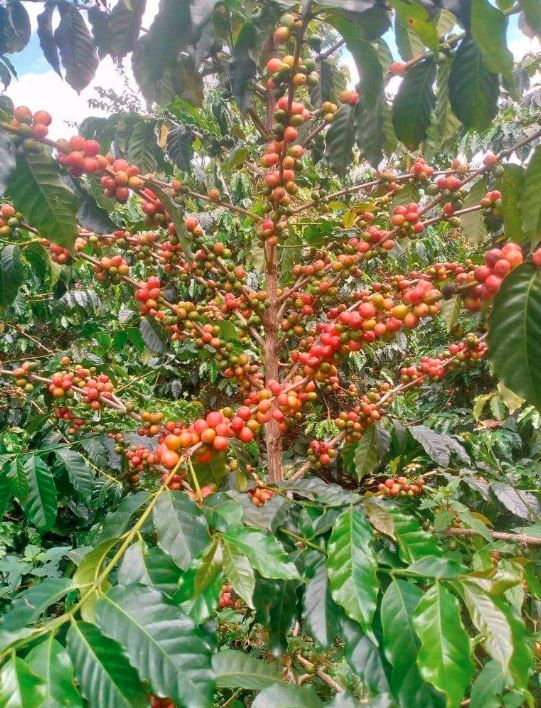
Coffee grows best in Altitude 1,200–2,100 meters above sea level with Temperature 15°C–26°C and Soil that is Deep, well-drained, fertile (slightly acidic) Ideal regions include Central Kenya (Nyeri, Kiambu, Kirinyaga) and parts of Eastern and Rift Valley.
2.) Select the Best Coffee Variety
Choose based on your goals SL28 / SL34 → Premium quality, higher market prices. Ruiru 11 → Disease-resistant, early maturity. Batian High yield, fast growth, good quality. Most new farmers prefer Ruiru 11 or Batian.
3.) Prepare the Land
Clear bushes, trees, and stumps, Deep ploughing to loosen soil, Dig planting holes: 2ft × 2ft × 2ft,Mix topsoil with manure before planting Good land preparation determines long-term yield.
4. Source Quality Coffee Seedlings
Buy from certified nurseries Healthy seedlings should be Dark green leaves, Strong stems and Disease-free Seedlings cost around KES 50–100 each
5. Plant Coffee Seedlings
Spacing:
2m × 2m (high density)
2.5m × 2.5m (recommended)
Best planting time:
Start of rainy season
Water immediately after planting
6. Mulching and Shade Management
Apply mulch (dry grass/leaves) to:
Retain moisture
Improve soil fertility
Introduce shade trees (agroforestry) Helps with climate control and better yields
7. Fertilization and Soil Management
Apply:
Organic manure (recommended)
NPK fertilizers
Conduct soil testing for best results
8. Weed Control and Farm Maintenance
Regular weeding reduces competition
Prune trees to:
Improve airflow
Increase productivity
Maintain clean farm conditions
9. Pest and Disease Control
Common threats:
Coffee Berry Disease (CBD)
Coffee Leaf Rust
Control methods:
Use resistant varieties (Ruiru 11, Batian)
Apply recommended pesticides
Regular farm inspection
10. Irrigation (Optional but Powerful)
Coffee is mostly rain-fed
But irrigation helps during:
Dry seasons
Flowering stage
Boosts yield and consistency
11. Harvesting Coffee
Begins after 2–3 years
Pick only ripe red cherries
Harvesting is done multiple times per season
12. Coffee Processing
Two main methods:
Wet processing (best quality, export market)
Dry processing (simpler, lower quality)
👉 Processing directly affects price
13. Selling Your Coffee
Options include:
Cooperative societies
Nairobi Coffee Exchange (auction)
Direct export contracts
👉 Quality = better price
Cost Item | Estimated Cost (KES) |
Land Preparation | 20,000 – 40,000 |
Coffee Seedlings (800–1,000 trees) | 40,000 – 100,000 |
Planting Labour | 10,000 – 25,000 |
Manure / Fertilizer (initial) | 20,000 – 50,000 |
Mulching & Shade Setup | 5,000 – 15,000 |
Irrigation Setup (optional) | 20,000 – 80,000 |
Pest & Disease Control | 10,000 – 30,000 |
Annual Labour & Maintenance | 30,000 – 80,000 |
Starting coffee farming in Kenya requires a significant initial investment, but it becomes profitable over time with proper management. Below is a realistic per acre cost breakdown (2026 estimates).
Coffee Yield Per Acre in Kenya

Lush green coffee plants in a nursery
Coffee yield per acre in Kenya varies depending on variety, farm management, soil fertility, and climate conditions. With proper practices, farmers can achieve high productivity and consistent income over time.
Buy or Sell Coffee in Kenya
Looking for coffee buyers?
Want to source high-quality Kenyan coffee?
👉 Connect with trusted farmers and suppliers
🔘 Submit your request🔘 List your coffee
Low yield (poor management): 500 – 800 kg of cherry per acre
Moderate yield (average farms): 800 – 1,500 kg per acre
High yield (well-managed farms): 1,500 – 2,500+ kg per acre
Under optimal conditions, yields can exceed 2,500 kg per acre
Yield Per Tree
Average yield per tree:
1 – 3 kg of coffee cherry per season
High-performing trees:
3 – 5 kg per tree
How Many Coffee Trees Per Acre?
Standard spacing:
2m × 2m → ~1,000 trees per acre
2.5m × 2.5m → ~800 trees per acre
More trees = higher potential yield (if well managed)
Yield by Coffee Variety
Variety | Yield Potential |
SL28 | Medium |
SL34 | High |
Ruiru 11 | High |
Batian | Very High |
Robusta | High |
Profitability of Coffee Farming in Kenya
Coffee farming in Kenya can be highly profitable, but returns depend on yield, coffee quality, management practices, and market prices. While the first few years require investment, coffee becomes a long-term income-generating crop once it reaches full production.
Coffee Processing Methods in Kenya
Coffee processing is one of the most important stages in coffee production, as it directly affects quality, flavor, and market price. In Kenya, coffee is mainly processed using wet (washed) processing, which is known for producing high-quality export-grade coffee.
1. Wet Processing (Washed Method)
Wet processing is the most common method in Kenya and is widely used by cooperatives and factories.
🔄 Steps Involved:
Harvesting – Only ripe red cherries are picked
Pulping – Outer skin is removed using a pulper machine
Fermentation – Beans are fermented to remove mucilage
Washing – Cleaned with fresh water
Drying – Beans are sun-dried to required moisture levels
✅ Advantages:
Produces high-quality coffee (AA, AB grades)
Better flavor, acidity, and aroma
Fetches higher prices in international markets
⚠️ Challenges:
Requires access to water
Higher processing costs
Needs proper management and equipment
2. Dry Processing (Natural Method)
Dry processing is simpler and is mainly used in:
Low-resource farms
Areas with limited water
🔄 Steps Involved:
Harvesting coffee cherries
Drying whole cherries under the sun
Hulling to remove dried outer layers
✅ Advantages:
Low cost
Simple to implement
Requires minimal equipment
⚠️ Challenges:
Lower quality compared to wet processing
Less consistent flavor
Lower market price
Coffee Marketing and Selling in Kenya

Coffee marketing in Kenya is structured to ensure quality control, transparency, and access to global markets. Farmers can sell their coffee through cooperatives, auctions, or direct export agreements, with prices largely influenced by quality and international demand.
1. Nairobi Coffee Exchange (Auction System)
The auction system is the most common way coffee is sold in Kenya.
How It Works:
Farmers deliver coffee to cooperative societies or millers
Coffee is processed, graded (AA, AB, PB)
Licensed brokers present it at the Nairobi Coffee Exchange (NCE)
Buyers bid competitively
Advantages:
Transparent pricing
Access to international buyers
Competitive bidding increases value
Challenges:
Payments may take time
Farmers depend on cooperatives and brokers
2. Direct Sales (Second Window)
Farmers and estates can sell coffee directly to international buyers through contracts.
How It Works:
Farmer/estate identifies a buyer
Negotiates price and quantity
Signs a direct export agreement
Advantages:
Faster payments
Better price control
Direct relationship with buyers
Challenges:
Requires connections and trust
Quality standards must be high
Export logistics knowledge needed
3. Cooperative Societies
Most smallholder farmers sell through cooperatives.
Role of Cooperatives:
Collect coffee cherries
Handle processing and marketing
Represent farmers at auction
Advantages:
Easier access to market
Shared resources (processing equipment)
Technical support
Challenges:
Profit sharing reduces individual earnings
Delayed payments in some cases
4. Export Markets
Kenyan coffee is mainly exported as green beans, with key markets including:
Europe
United States
Asia
High-quality Kenyan coffee is globally recognized for:
Bright acidity
Rich flavor
Premium grading (AA, AB)
5. Local Market (Growing Opportunity)
Domestic coffee consumption in Kenya is still low but growing steadily.
Opportunities include:
Local roasting businesses
Coffee shops and brands
Packaged coffee products
👉 This is a huge untapped market for farmers and entrepreneurs.
What Determines Coffee Prices in Kenya?
Coffee grade (AA, AB, PB)
Processing method (wet = higher value)
Global market prices
Supply and demand
Challenges Facing Coffee Farmers in Kenya
1. Climate Change and Unpredictable Weather
Climate change has significantly affected coffee farming in Kenya through:
Irregular rainfall patterns
Prolonged droughts
Rising temperatures
This leads to:
Reduced yields
Poor flowering and fruit development
Increased pest and disease pressure
2. Pests and Diseases
Coffee farmers struggle with major diseases such as:
Coffee Berry Disease (CBD)
Coffee Leaf Rust (CLR)
Effects:
Reduced yields
Increased production costs (sprays, chemicals)
💡 Solution trend:👉 Adoption of resistant varieties like Ruiru 11 and Batian
3. High Cost of Inputs
The cost of:
Fertilizers
Pesticides
Labour
has been rising steadily.
This reduces profit margins, especially for small-scale farmers.
4. Price Fluctuations in Global Markets
Coffee prices in Kenya are influenced by:
International commodity markets
Supply and demand
Result:
Unpredictable income
Difficulty planning long-term investments
5. Inefficiencies in Cooperative Systems
Many farmers rely on cooperatives, which sometimes face:
Delayed payments
Mismanagement
Lack of transparency
This affects farmer trust and cash flow.
6. Declining Coffee Production Areas
Urbanization and land subdivision have reduced:
Land under coffee farming
Large-scale production
Many farmers are switching to:
Real estate
Other crops
7. Labour Shortages
Coffee farming is labour-intensive, especially during:
Harvesting
Pruning
Maintenance
Rising labour costs and shortages affect farm operations.
8. Limited Access to Information and Technology
Some farmers lack:
Modern farming knowledge
Access to improved technologies
Market information
This limits productivity and efficiency.
9. Water Scarcity and Irrigation Challenges
Coffee is mostly rain-fed
Irrigation systems are expensive
👉 Water shortages reduce yield and consistency.
Opportunities in Coffee Farming (2026 and Beyond)
1. Growing Global Demand for Kenyan Coffee
Kenyan coffee is globally recognized for its premium quality, and demand continues to rise:
Coffee exports are growing steadily
New markets like the Netherlands and Asia are expanding rapidly
Global consumption is increasing, especially for specialty and premium coffee
This means High-quality Kenyan coffee will always have buyers
2. Value Addition
Currently, most Kenyan coffee is exported as raw green beans, meaning farmers lose potential profits.
Opportunities:
Coffee roasting and packaging
Branding Kenyan coffee locally and internationally
Selling finished products instead of raw beans
Value-added coffee can earn 2–5x more than raw coffee
3. Rising Local Coffee Consumption
Kenya’s domestic coffee market is expanding:
Growth in coffee shops and urban coffee culture
Increasing number of cafés and local brands
More young consumers adopting coffee
Opportunity Sell locally instead of relying only on exports
4. Agroforestry and Climate-Smart Farming
Modern coffee farming is shifting towards:
Shade-grown coffee
Agroforestry systems
Sustainable farming practices
Benefits:
Higher yields
Better quality
Climate resilience
This also opens doors for: Carbon credits and sustainability funding
5. Direct Trade and Export Opportunities
Farmers are increasingly bypassing traditional systems:
Direct sales to international buyers
Specialty coffee contracts
Online coffee trading platforms
👉 Advantage:
Better pricing
Faster payments
Strong buyer relationships
6. Government Support and Sector Reforms
Kenya is actively working to revive the coffee sector:
New strategies to increase farmer earnings
Expansion of production zones
Improved trading transparency through technology
Goal:Make coffee a top foreign exchange earner again
7. Technology and Digital Transformation
The future of coffee farming is digital:
Farm management tools
Digital marketplaces
Data-driven farming
👉 Result:
Higher efficiency
Better decision-making
Access to global markets
8. Agribusiness and Side Opportunities
Beyond farming, coffee opens multiple income streams:
Coffee seedling nurseries
Coffee processing businesses
Export brokerage
Equipment supply (pulpers, irrigation systems)
9. Production Expansion Potential
Kenya currently produces far below its historical peak, meaning Huge room for expansion, Government targeting increased production and More land being opened for coffee farming Opportunity for early adopters will benefit most
How many coffee trees can be planted per acre in Kenya?
On average, 1 acre can accommodate 800–1,100 coffee trees, depending on spacing. Standard spacing is 2m × 2m or 2.5m × 2.5m, which directly affects yield and management efficiency.
How long does coffee take to grow in Kenya?
Coffee takes about 2–3 years to start producing cherries and reaches full production after 4–5 years. With proper management, a coffee tree can remain productive for 20–30 years.
Which coffee variety is best in Kenya?
The best varieties depend on your goals SL28 & SL34 fetches High quality, premium prices, Ruiru 11 is disease-resistant, early maturity while Batian is High yield, good quality, faster maturity. For most farmers today, Ruiru 11 and Batian are preferred due to resilience and productivity.
Is coffee farming profitable in Kenya in 2026?
Yes, coffee farming can still be profitable if well managed. Profit depends on Yield per tree, Market price per kg and Farming practices.With good management, farmers can earn KES 80–130+ per kg, making coffee a viable long-term investment.
How much does it cost to start coffee farming in Kenya?
The cost varies, but on average Seedlings 50Ksh–100Ksh per seedling, Land preparation & planting KES 20,000–50,000 per acre while Inputs & labor (annual) 30,000Ksh–80,000Ksh. Total startup cost per acre can range from 80,000Ksh to 200,000Ksh depending on scale and practices.
How much coffee can one acre produce in Kenya?
A well-managed acre can produce 800–2,000 kg of cherry per season
Yield depends on Variety, Soil fertility, Pest and disease control and Farm management practices
What are the main coffee growing areas in Kenya?
Coffee is grown in highland regions including Central Kenya (Nyeri, Kiambu, Murang’a, Kirinyaga),Eastern (Embu, Meru, Machakos) and Rift Valley & Western highlands .These areas have cool temperatures, volcanic soils, and reliable rainfall.
What are the main challenges in coffee farming in Kenya?
Key challenges include Coffee Berry Disease (CBD) and Leaf Rust, Climate change and unpredictable rainfall, High input costs, Price fluctuations in global markets
How is coffee sold in Kenya?
Coffee is sold through Nairobi Coffee Exchange (auction system) and Direct sales (export contracts). Prices depend on quality, grading, and global demand.
What is the difference between wet and dry coffee processing?
Wet processing Produces high-quality coffee (used for export) and Dry processing Simpler and cheaper but lower quality. Most Kenyan coffee is wet processed, which gives it premium value globally.
Can coffee farming be done on a small scale?
Yes. Many Kenyan farmers operate on less than 1 acre. With proper management and good varieties, small-scale farming can still be profitable.
What is the best spacing for coffee trees?
Recommended spacing is 2m × 2m (high density) while 2.5m × 2.5m (better airflow and management).Proper spacing improves yield, disease control, and harvesting efficiency.
Does coffee require irrigation in Kenya?
Coffee is mostly rain-fed, but irrigation is beneficial during Dry seasons and Flowering and fruit development stages Irrigation helps increase yield and consistency.
What fertilizers are used in coffee farming?
Common inputs include NPK fertilizers, Organic manure/compost and Lime (to correct soil acidity).Soil testing is recommended for best results.
What opportunities exist in the coffee business in Kenya?
Beyond farming, opportunities include Coffee export business, Value addition (roasting & packaging), Coffee nursery and seedling sales and agroforestry integration



A good Online Calculator should be straightforward enough for anyone to use without reading lengthy instructions. Quick access to basic arithmetic, percentages, and totals can make studying, budgeting, and comparing prices much more convenient.
Dinosaur Game rewards patience more than luck. Learning obstacle patterns and keeping a steady rhythm is the secret to reaching impressive scores.