
Cashew Nut Tree: Benefits, Growing Conditions & Yields

Updated: Dec 1, 2025

1.)About the Cashew Nut Tree
3.)How Long Do Cashew Trees Take to Grow
4.)Cashew Nut Tree Varieties
the cashew is one of the few examples of a seed that grows outside its own fruit.

Diagram of a cashew showing yellow cashew apple by Otieno Israel
India is the world's largest producer of cashew nuts.
The cashew tree (Anacardium occidentale) is native to Northeastern Brazil, where indigenous communities first harvested its seeds and fermented the cashew apple into traditional beverages. In the 16th century, Portuguese explorers spread the crop to India, Mozambique, Tanzania, Kenya, and other tropical regions, where it adapted exceptionally well to warm, coastal climates.
the cashew apple is also used to make juice, wine, jams, and animal feed.

Cashew processing is complex and dangerous Cashew factories must heat the shell to destroy urushiol, remove the shell without breaking the seed, Wash and roast cashew kernels, Peel off the thin inner skin then Grade and package .This is labor-intensive and is one reason cashews are more expensive than peanuts, almonds, or macadamia

I think the market for cashew will expend more and more because of the vegan movement. Cashews are used as a milk replacer in many vegan recipes, making vegan cheese, vegan mayonnaise and cashew milk ... More and more people decide to go vegan because of the environmental and health benefits.- Wierner
What sets cashew nuts apart is that they are not true nuts but rather seeds that grow outside the cashew apple. The seed is encased in a double shell containing urushiol, the same irritating compound found in poison ivy.

Because of this, cashews require careful processing—steaming or roasting the shells to neutralize toxins before the edible kernel can be safely extracted. This labor-intensive process contributes to their higher market price. Cashew nuts are rich in protein, healthy monounsaturated fats, copper, magnesium, zinc, and antioxidants that support heart health, brain function, immunity, and bone strength.
Want To Learn More About The Melia Volkensi Tree AKA Mukau Click Here >>>>
From the macadamia group, the out of Africa says, cashew nuts are growing selfly in the forest while macadamia is grown by farmers so making cashew nuts value (low)price than of macadamia thus discouraging coastal farmers from growing it more like the 80s and early 90s- Hassan Mwalimu

Image of a Cashew Tree by Captain Green Ke
What makes cashew nuts particularly special is their complex processing method. Each seed is enclosed in a double-layered shell that contains urushiol—an irritant also found in poison ivy. This means cashews must be roasted or steamed before shelling to make them safe for consumption. Once processed, the nuts are sorted, dried, and peeled to reveal the edible kernel.

Cashew Nut is locally known as Mkorosho or mkanju in Swahili language and Mukoloso or Kikoloso in kamba language

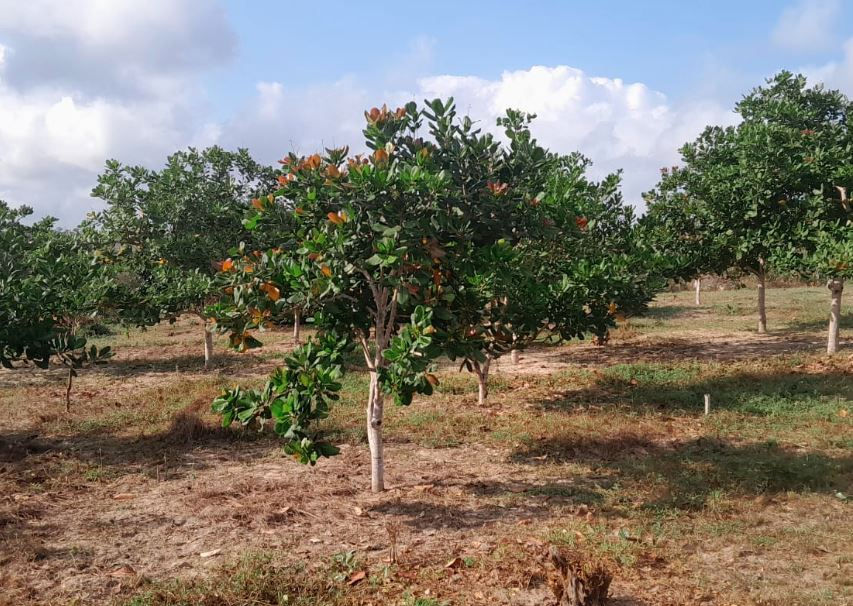
Image of a 2 year old Cashew Nut Tree by Markson Kimeli
The cashew nut is not actually a nut, but rather the seed of the cashew apple. What we call the “cashew nut” is actually a seed
Cashew trees grow best in tropical and subtropical regions with warm temperatures, low humidity, and well-drained soils.
Want To Learn More About Mzambarau Tree Click Here >>>>

They thrive in areas that receive 500–1,200 mm of annual rainfall, making coastal zones ideal. Originally native to Brazil, cashew trees are now widely cultivated across East Africa, West Africa, India, Vietnam, Sri Lanka, Indonesia, and parts of Australia. In Africa, major producers include Kenya, Tanzania, Mozambique, Nigeria, and Benin. They perform exceptionally well in sandy, lateritic soils and tolerate drought better than many fruit trees, allowing farmers in hot, dry regions to harvest consistently even under challenging weather conditions.

Image of a dwarf Cashew cultivar, growing up to 6 m (20 ft)
Under good management, a cashew tree begins to flower and produce its first fruits in the 3rd year after planting, although early yields are usually low. By the 5th to 7th year, the tree reaches full bearing capacity and produces consistent annual harvests. Peak productivity occurs between 8 and 15 years, after which yields gradually decline. The tree remains economically viable for about 25 years.
Growth rate depends on rainfall, soil depth, spacing, and whether grafted seedlings were used, with grafted varieties generally fruiting earlier than trees grown from seed.
Cashew Nut Tree Varieties

Image of a Cashew Fruit by Captain Green Ke
New hybrid varieties are less in height and more in fruits.
Cashew nut tree varieties differ in nut size, yield potential, flowering time, and resistance to pests such as powdery mildew. In Kenya, the most recommended varieties are A75/83, A100, A81, and A82, developed and approved by KALRO for their high productivity and adaptability to coastal climates. These improved varieties produce larger kernels, offer better shelling recovery, and begin bearing earlier than traditional seed-grown trees. Internationally, cashew varieties are grouped into Brazilian, Indian, and African types, each selected for drought tolerance and canopy structure. Farmers are encouraged to plant certified or grafted varieties to guarantee consistent yields and long-term orchard performance.
Originated in South America. Was spread to all the countries - mostly African during colonial times.

Cashew nut planting should begin at the start of the rainy season to ensure proper establishment. Start by digging 60 cm × 60 cm × 60 cm holes, allowing them to collect and store moisture. Mix topsoil with well-decomposed manure before planting. For direct seeding, place three seeds per hole, then thin to the strongest seedling after two months. Grafted seedlings can also be planted for faster and more uniform production. Maintain a spacing of 7.5 m × 7.5 m or 8 m × 8 m to allow full canopy development. Keep the area weed-free, mulch around the base, and water young seedlings regularly until established.

Cashew processing begins immediately after harvesting by separating the nut from the cashew apple. The apples can be processed into juice, wine, jam, and animal feed due to their high Vitamin C content. The nuts are sun-dried for 2–3 days to reduce moisture, then roasted or steamed to neutralize the toxic shell oil (urushiol). After heating, the hard shell is cracked to extract the kernel, which is further dried, peeled, graded, and packed for safe storage and export.
Cashew Nut Benefits

Cashew nuts are highly nutritious, offering a rich source of healthy fats, plant protein, fiber, magnesium, zinc, and antioxidants. Their monounsaturated fats support heart health, while magnesium helps regulate blood sugar and improves nerve and muscle function. The fiber content aids digestion and promotes better weight management by increasing satiety. Cashews also boost immunity, strengthen bones, and provide sustained energy. Their nutrient profile makes them a valuable addition to both everyday diets and specialized health-focused meal plans.
In case of severe attack, spraying of carbaryl (0.1%) can be taken up. Monocrotophos sprayed to control TMB will also control such pest infestation. -Monis Plant Hub

Powdery mildew is the most destructive disease, causing white fungal patches on leaves and flowers, leading to poor fruit set. Anthracnose attacks young shoots and nuts, causing dark lesions, dieback, and premature nut drop. Stem and root borers tunnel into the trunk, weakening the tree and sometimes killing it. Other pests include tea mosquito bugs, which suck sap from young shoots and cause black lesions, and leaf miners, which damage tender leaves. Effective management includes timely pruning, sanitation, resistant varieties, and recommended fungicide or insecticide applications.
Cashew Market Prices & Profitability

In Kenya, raw cashew nuts typically range between 80Ksh–150 per kg, while processed kernels fetch much higher prices, from 800Ksh–1,800 per kg depending on grade (W180, W210, W240, W320). Profitability is strongest for farmers who produce high-quality nuts and for processors who add value through shelling, roasting, and grading.
A well-maintained cashew orchard can yield 3–4 kg per tree
FAQ About Cashew Nut Farming
Are cashew nuts actually nuts?
No. Cashews are technically seeds, not true nuts. They grow outside the cashew apple and are enclosed in a shell containing toxic oil (urushiol), which must be removed through careful processing.
How long do cashew trees take to start producing nuts?
Cashew trees begin yielding from the 3rd year, reach full production in 5–7 years, and remain economically productive for about 25 years.
Hi, I’m Evans. Need Data Research or Analysis?
I help businesses gather the right data and turn it into actionable insights.
Cashews thrive in warm, low-altitude tropical climates with 500–1,200 mm of rainfall. They grow well in Kenya’s coastal counties and other hot, dry regions.
we used to grow like 5tns annually but we used to get very little cash on its sales especially raw therefore we decided to just do away with it by cutting the cashew trees-Hassan Mwalimu
How much does one cashew tree produce per year?
A mature cashew tree typically yields 3–4 kg of nuts annually, depending on variety, soil quality, and management practices.
What are the recommended cashew varieties in Kenya?
KALRO recommends high-performing varieties such as A75/83, A100, A81, and A82, known for high yields and better disease resistance.

Is cashew farming profitable in Kenya?
Yes. With rising global demand, processed cashews can sell for 800Ksh–1,800 per kg, making cashew farming highly profitable, especially for farmers who add value through processing.
Major diseases include powdery mildew, anthracnose, and pests like stem borers, leaf miners, and tea mosquito bugs.
Can you eat the cashew apple?
Yes. The cashew apple is rich in Vitamin C and used to make juice, wine, jams, and animal feed. It spoils quickly, which is why it is not widely sold in markets.
Why are cashew nuts never sold in shells?
Cashew shells contain urushiol, a toxic resin. They must be steamed or roasted to neutralize the toxin before the kernel can be safely extracted.
The main harvesting season is between March and May, when most trees reach peak nut production.


Comments