
Melia volkensii (Mukau Tree): The Ultimate Drought-Resistant Timber Tree for Arid Lands

Updated: Jan 14

5.)Melia Volkensii Field establishment & management
6.)Challenges of Growing Melia Volkensii
7.)Melia Volkensii Tree Timber
8.)Mukau Tree Profitability
9.)Pests & Diseases affecting Melia Volkensii Tree
Maturing at 8 years old, Melia allows farmers to earn income from timber, firewood, and intercropping. Unlock the potential for sustainable agriculture.

Melia volkensii is a termite resistant tree found only in Eastern Africa. The species produces high quality timber.
Melia volkensii, commonly referred to as the Mukau tree, is a fast-growing, drought-tolerant hardwood species native to the arid and semi-arid regions of East Africa. It is increasingly gaining recognition for its multiple benefits, particularly in areas where rainfall is scarce, soils are poor, and deforestation is a concern.
KSh 9,300 net per tree after sawing costs; farm-gate buyers may target ~KSh 8,000 per tree.
Save Indigenous Tree Seeds Before They Are Lost Forever

Image of a Melia Volkensii Tree by Captain Green Ke
Melia volkensii belongs to the Meliaceae family, which also includes neem and mahogany. It is a deciduous tree that grows up to 15–20 meters in height under ideal conditions.
Want To Learn More About Prunus Africana Tree Click Here >>>
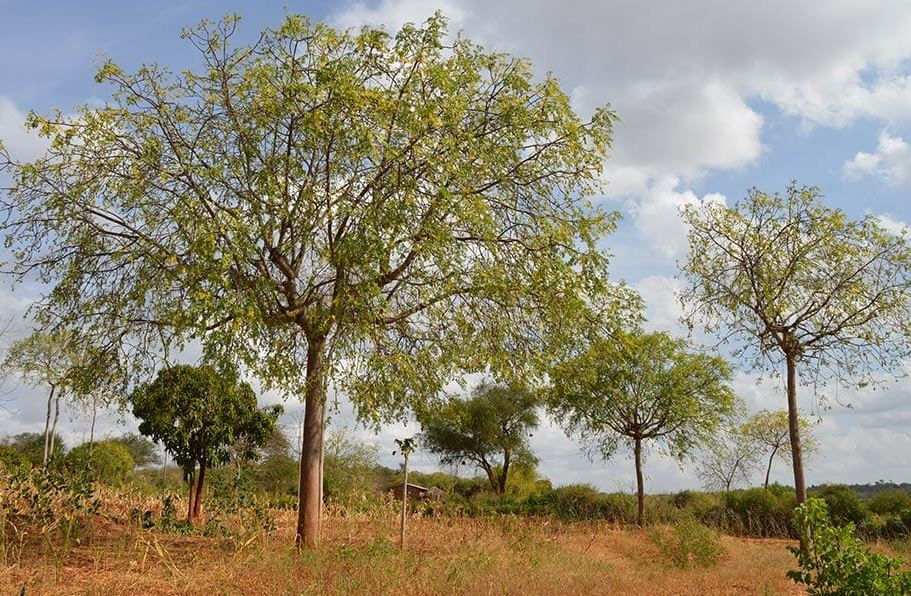
Compound leaves that are bipinnate and bright green, resembling those of neem but larger. Flowers are small, fragrant, and purplish, usually appearing before or with the new flush of leaves. Fruits are round, green fruits that turn yellow when ripe. Each fruit contains one to four seeds. Bark: Light brown and smooth in young trees but becomes rough with age.
🌱 Ready to Start Your Mukau Journey?
Order certified Melia Volkensii (Mukau) seedlings and get a free planting guide.
📩 Click here to place your order now or request a call back — let’s help you grow a profitable Mukau plantation today!”
In times of drought, Melia volkensii sheds its leaves to conserve water, a natural defence that ensures its survival in harsh, arid conditions.Once the rains return, it rapidly re-foliates and resumes growth, a true example of nature-based resilience in dryland forestry. -Better Globe Forestry

One of the most remarkable features of Mukau is its exceptional adaptability to dryland conditions. It is native to lowland areas of Kenya, Tanzania, and Ethiopia, typically thriving in regions with an annual rainfall of 400–800 mm and an Altitude range of 400 to 1,600 meters above sea level .It requires well-drained, sandy to loamy soils.
Want To Learn More About Muthiga Tree Click Here>>>>

Melia Volkensii does not do well in waterlogged conditions. Mukau Tree thrives in hot conditions with mean temperatures between 20°C and 35°C .This adaptability makes Melia volkensii a key species for agroforestry, afforestation, and reforestation programs in arid and semi-arid lands (ASALs).
Melia Volkensii English & Local Names

Image of a Melia Volkensii by The Taita Taveta County Government
It is referred to as Mukau in both Kamba Language , Kikuyu Language , Tharaka Language and Mbeere language. It is referred to as Tile in Boran language.It is referred to as Bamba Tree in Oromo Language .It is referred to as Maramarui in Samburu Language .It is referred to as Boba Tree in Somali andkirumbutu in Taita Language
Want To Learn More About Baobab Tree Click Here>>>>
Seed, nursery & propagation of Melia Volkensii

Collect fruits from the tree crown when ripe (yellow with brown patches). Avoid naturally fallen fruits (often immature/infested). Store temporarily under shade in non-airtight bags.
De-pulp right after harvest; mortar & pestle or plank-and-stone. Sun-dry nuts for less than 2 days. Rule of thumb: 7 kg fruits consist of 1 kg clean nuts.
🌱 Ready to Start Your Mukau Journey?
Order certified Melia Volkensii (Mukau) seedlings and get a free planting guide.
📩 Click here to place your order now or request a call back — let’s help you grow a profitable Mukau plantation today!”
Extract seed using a dedicated Melia nut-cracker or a knife + grooved plank; fresh seeds look brown, old de-pulped nuts yield black seed. Sow immediately; use within 1 month to avoid loss of viability.

Image of Melia Volkensii Seeds by Captain Green Ke
Propagation of Melia volkensii can be done through seeds or vegetative methods like grafting. However, seed propagation is the most common.
Seed pre-treatment (to break dormancy)
Nip off the sharp tip; 2) Soak in cold water 12–24 h; 3) Slit the seed coat longitudinally with a sterile blade (avoid the radicle). Keep conditions very clean to prevent fungi.
.

Image of a 3 month Old Melia Volkensi by Steve Muema
Sowing & germination

Image of Melia Volkensii Seedlings by Better Globe Forestry
Sow immediately after slitting in sterilised river sand inside a non-mist propagator/tunnel; cover with sand twice seed thickness, drench with fungicide, keep chamber humid. Germination: 3–6 days. Cool months (June/July) and very rainy periods are poor for germination.
Melia Volkensii Field establishment & management

Image of Workers working on Melia Volkensii at BGF Better Globe Forestry
Site selection & preparation
Choose well-drained sandy/sandy-loam/sandy-clay, no water-logging; avoid rocky/poor sites; ensure access for operations.
Deep ripping
To break hardpan improves infiltration and early root growth; uprooted bush can be used as dead fencing.
Site prep methods
spot hoeing, strip cultivation (1–3 m strips along contours, 10–30 m apart), or complete cultivation—manual (machete/hoe) or mechanical (oxen/tractor/bulldozer) for large scale.
Fence
To protect from donkeys/goats/cows that debark Melia; keep fence for life of stand.
As the demand for sustainable wood products rises globally and deforestation pressures increase, Melia volkensii stands out as a beacon of hope for: Restoration of degraded drylands Creation of green jobs in arid regions Sustainable timber production Climate change adaptation
Spacing options
5 m × 5 m (400 trees/ha): canopy closes ~6–7 years, then start thinning. A guide to on-farm Melia volken…
10 m × 5 m (200 trees/ha): better for intercropping (cowpeas/green gram); lines weeded by crop maintenance

Image of Melia Volkensii Seedlings by Better Globe Forestry
Pit size at least 45 × 45 × 45 cm; dig in dry season, keep topsoil separate, then refill with topsoil first (mix subsoil with manure if available).
Transplant early in the rains (after soils hold clumps a day after rainfall). Root collar at ground level, roots pointing down (don’t bend). Gently loosen the root plug after placing; firm by hand then foot.
Water harvesting: build micro-catchments, but plant the seedling 15–20 cm downslope OUTSIDE the barrier to avoid water-logging. Optional soil mix for pits: soil:manure:ashes:charcoal dust = 6:2:1:1.
🌱 Ready to Start Your Mukau Journey?
Order certified Melia Volkensii (Mukau) seedlings and get a free planting guide.
📩 Click here to place your order now or request a call back — let’s help you grow a profitable Mukau plantation today!”
Melia is sensitive to weed competition and water-logging early on—clean weed (mechanically or carefully with glyphosate in strips) until canopy closes. Avoid spraying foliage.
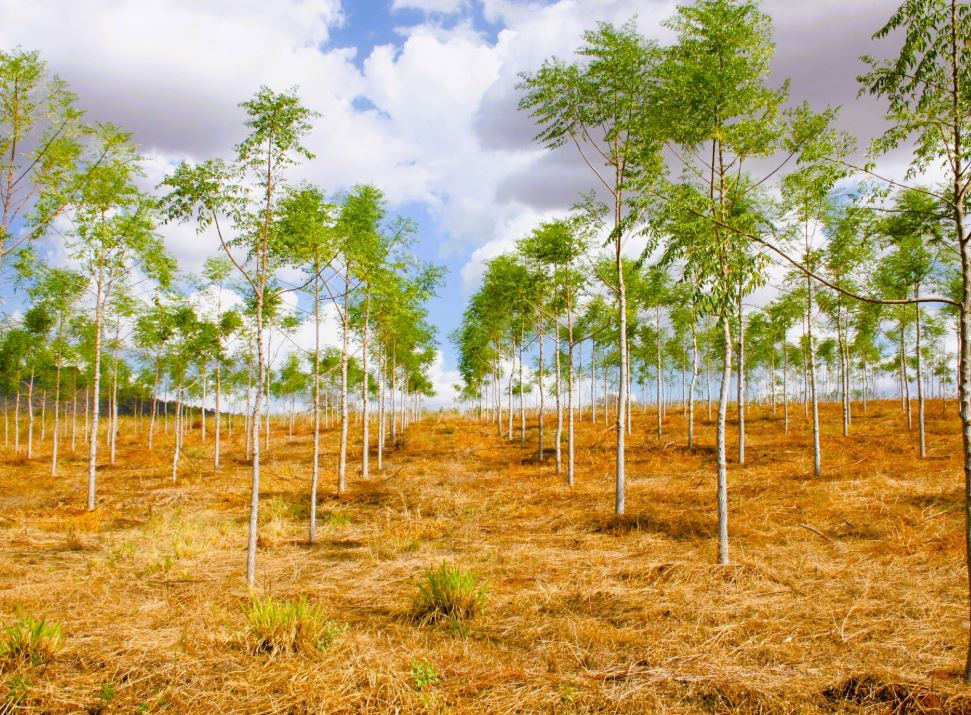
Image of Melia Volkensii Tree at Better Globe Forestry
De-bud only in year 1 in order to remove tiny buds by hand up to half the tree height; repeat 3× in year 1 (secateurs if needed). Note: some growers skip de-budding to keep foliage for photosynthesis.
Pruning (from year 2)
– Remove double leaders early; selectively prune branches more than 2.5 cm and reduce whorls to balance the crown.
– Target a clear bole up to ~8 m by age ~5 (max ⅔ of tree height at any pruning).
– Time: just before rains; disinfect tools (e.g., hydrogen peroxide). Use under-cut then over-cut technique to prevent bark tearing. Avoid over-pruning (causes epicormic shoots); use a ladder to prune high.
Thinning of Melia Volkensii
1st thinning: at 6–7 years, reduce from 400 → 300 trees/ha (remove dead/weak/diseased/deformed; then small/heavily-branched if needed).
2nd thinning: about 3 years later, 300 → 200 trees/ha; aim for uniform spacing of retained trees. Best done in dry season.
Approaches: qualitative (mark inferior trees first), or quantitative (mechanical selection/remove alternate trees or rows).
Harvest & rotation of Melia Volkensii
Harvest from 12 years once DBH greater than 30 cm; wood properties don’t change much with age after this. Larger DBH 40–50 cm (premium planks) on good sites at 15–20 years.
Pests/diseases in mature stands
Occasional cankers, mites, fungi; heart-rot risk rises ≥20 years—no cost-effective fungicide. Prevention: minimise large pruning wounds, prune early, remove broken stubs, have a forester check & remove infected trees early.
Where Melia Volkensii Grows

Image of Melia Volkensii Tree stand by Better Globe Forestry
Melia Volkensii grows in Ethiopia, Kenya, Somalia, Tanzania. With the best sites having well-drained sandy/sandy-loam/sandy-clay soils, gentle slope, altitude 0–1,700 m, rainfall 300–800 mm, temps 26–38 °C
Management Practices
To ensure good growth and yield, several practices should be observed:
Weeding: Especially in the first two years to reduce competition for nutrients and moisture.
Pruning: Necessary to shape the tree, reduce branching, and promote straight boles for timber production.
Pest and disease control: Generally resistant but can suffer from termite attacks and shoot borers.
Thinning: For plantations, thinning may be done after 3–5 years to reduce competition and allow selected trees to mature optimally.
Its ability to survive in arid conditions while producing high-quality timber makes it an invaluable asset for sustainable development.
Benefits of Melia Volkensii

Image of a Melia Volkensii watch by Better Globe Forestry costing KES 6,960 (VAT inclusive)
Premium Timber
Comparable to mahogany — termite-resistant, durable, and easy to work with

Image of Melia Volkensii Watch by Better Globe Forestry
Fast Growth
Reaches harvestable size (30+ cm DBH) in 12–15 years under good management
Environmental Value
Reduces deforestation pressure, provides shade, supports bee-keeping
Extra Uses
Poles, posts, firewood, medicinal uses, and even livestock fodder
Pests & Diseases affecting Melia Volkensii Tree
Fungal diseases: Fusarium root rot, damping-off, powdery mildew — control with fungicides (Ridomil, copper sprays)
Nematodes: Heat-sterilise nursery soil or solarise for 2 months
Spider mites: Control with acaricides every 10–14 days
Challenges of Growing Melia Volkensii
Despite its advantages, Melia volkensii cultivation faces several challenges:
Slow initial growth: In the first year, growth may be slow, requiring patience and care.
Seed dormancy and low germination rates: Without proper pretreatment, seeds have low viability.
Limited quality planting materials: There is a need for improved and certified seedlings to ensure uniform growth and better wood quality.
Poor farmer knowledge: Lack of awareness about best management practices can lead to poor results.
Melia Volkensii Tree Timber

Image of Melia Volkensii Timber by Better Globe Forestry
Example sawn pieces (4×2×15’ ×2; 3×2×15’ ×10; 2×1×15’ ×6) total 270 running feet at typical prices = KSh 12,000; sawing cost ~KSh 2,700, net ≈ KSh 9,300 per tree. A buyer’s target cost for a farm tree is ~KSh 8,000 (after transport & margin).
Other revenue lines baked into tables: cowpea grain (6 seasons) up to KSh 1,920,000, off-cuts KSh 280,000, 1st thinning KSh 100,000, 2nd thinning KSh 280,000 (timber).
Mukau Tree/Melia Volkensii Tree Profitability

Image of Melia Volkensii Timber by Better Globe Forestry
A well-managed tree yields ~270 running feet of sawn timber worth KSh 12,000, minus sawing costs (KSh 2,700) = KSh 9,300 net profit per tree.
Spacing | Trees/Ha | Net Income (18 yrs) | Gross Income (Roundwood) | Gross Income (Sawn Timber) |
10 × 5 m | 200 | KSh 3,884,800 | KSh 3,520,000 | KSh 4,603,000 |
5 × 5 m | 400 (after thinning) | KSh 2,670,000 | KSh 2,670,000 | KSh 3,753,000 |
Sell sawn timber rather than standing trees — prices are higher
Stick to pruning & thinning schedule to get tall, knot-free logs
Combine with intercropping for early income from cowpeas, green grams, or sorghum
FAQ About Melia Volkensii Tree

Image of Melia Volkensii Tree by Better Globe Forestry
Which is the best region to plant Mukau tree?
Semi-arid regions with 300–800 mm annual rainfall like Kitui, Makueni, Tharaka Nithi, and Embu drylands.
How long does Melia Volkensii take to mature?
Typically 12–18 years to 30 cm DBH (harvest standard). Bigger (40–50 cm DBH) in 15–20 years on good sites/management.
Is Mukau timber profitable?
Yes a well-managed stands can generate KSh3–4.6M per hectare over an 18-year rotation.
How do I care for Mukau seedlings?
Provide partial shade early, water sparingly (avoid waterlogging), and plant when seedlings are 30+ cm tall.
Melia volkensii is widely known in Kenya as Mukau. Different communities also have their own names — for example, Tile (Boran), Bamba (Oromo), Maramarui (Samburu), Boba (Somali), and Kirumbutu (Taita). "Mukau" is the most common name used, especially among Kamba, Tharaka, and Mbeere farmers

Save Indigenous Tree Seeds Before They Are Lost Forever


Comments