
Red Maple-Acer rubrum-Indigenous Trees of North America: Names, Uses & Conservation Status

Updated: Jan 15

Image of Rows of Red Maple Acer rubrum trees with vibrant red leaves in a field under clear blue sky,
1.)Everything About The Red Maple (Acer rubrum)
2.)Scientific Classification of Red Maple
3.)Common Names of Red Maple Across North America
5.)Natural Habitat and Geographic Distribution
6.)Physical Characteristics of Red Maple
8.)Ecological Importance of Red Maple
9.)Traditional and Modern Uses of Red Maple
11.)Conservation Status of Red Maple
12.)Red Maple in Climate Change Adaptation
13.)Is Red Maple Suitable for Urban Planting?
15.)Frequently Asked Questions About Red Maple
Red Maple (Acer rubrum) is a native North American tree valued for timber, shade, wildlife support, and fall color.

The Red Maple (Acer rubrum) is one of the most widespread and adaptable native trees in North America, found naturally across eastern and central regions of the United States and Canada. It is a deciduous hardwood tree admired for its rapid growth, tolerance to varied soils, and striking seasonal beauty. Red Maple typically grows 18–27 meters (60–90 feet) tall, forming a broad, rounded canopy that provides excellent shade.
🌱 Not Sure Which Tree Is Right for Your Space?
Get expert guidance on native trees, spacing, growth rate, and long-term maintenance.

Red Maple red seedling sprouting from dark soil under sunlight by BonsaiBox
One of its most defining features is its vibrant red coloration, visible in its flowers, leaf stems, seeds (samaras), and especially its brilliant red to orange fall foliage. The leaves are usually three- to five-lobed, turning color earlier than many other hardwoods. Red Maple thrives in full sun to partial shade and can grow in environments ranging from wetlands to upland forests, making it highly resilient.
A Red Maple (Acer rubrum) is green for most of the year. The “red” name does not mean the leaves stay red year-round.Red Maples turn red mainly in autumn. In spring and summer, healthy leaves are green because chlorophyll dominates.

Ecologically, Red Maple supports pollinators, birds, and small mammals, while its early spring flowers provide an important nectar source. It is widely used in urban landscaping, reforestation projects, and residential planting due to its adaptability.
Although its wood is softer than sugar maple, Red Maple remains a keystone native species valued for both environmental and aesthetic benefits.

Red Maple Bonsai by Bonsai Box
The Red Maple is scientifically classified as Acer rubrum and belongs to the Sapindaceae family, which includes maples and horse chestnuts. It falls under the genus Acer, a group known for distinctive lobed leaves and winged seeds called samaras. Red Maple is a deciduous hardwood species within the order Sapindales and the kingdom Plantae, reflecting its close evolutionary relationship with other temperate forest trees of North America.
The Red Maple (Acer rubrum) is one of the first trees to change color in autumn, often turning red weeks before other hardwoods.
Common Names of Red Maple Across North America
The Red Maple (Acer rubrum) is known by several common names across North America, reflecting its wide distribution and distinctive features. These names include Red Maple, Swamp Maple, Soft Maple, Water Maple, and Scarlet Maple. The name often varies by region and habitat, with “Swamp” or “Water” Maple commonly used in wetter areas, highlighting the tree’s adaptability to diverse environments.
Is Red Maple Indigenous to North America?
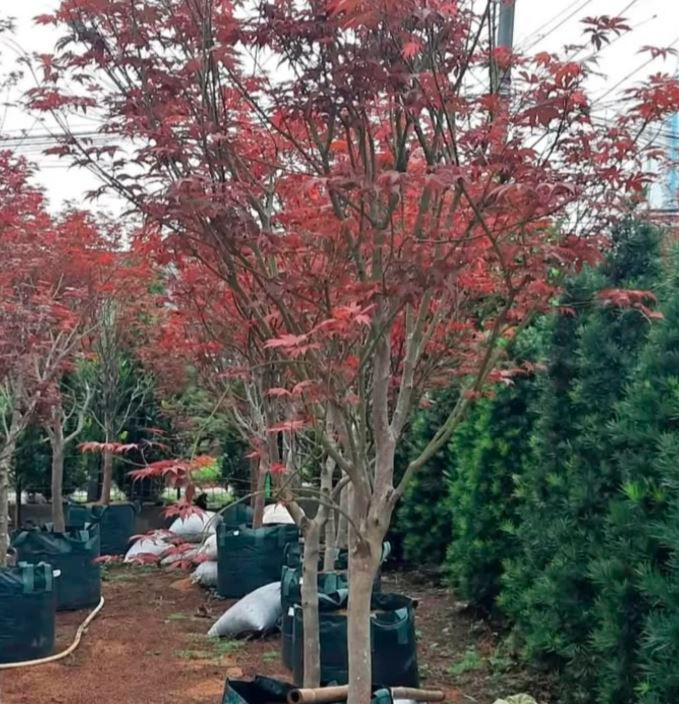
Red Maple Tree by kreasi_garden
Yes, the Red Maple (Acer rubrum) is indigenous to North America. It is native to a broad range extending from eastern Canada through the eastern and central United States. Red Maple has evolved naturally in North American forests for thousands of years and is considered one of the most widespread native hardwood trees on the continent, thriving in wetlands, floodplains, uplands, and mixed forests.
🌳 Planning to Plant a Tree Near Your Home?
Avoid costly mistakes. Get personalized tree recommendations for your location.
👉 Get a Tree Recommendation
Natural Habitat and Geographic Distribution

The Red Maple (Acer rubrum) naturally occurs across eastern and central North America, from southern Canada to the southeastern United States. It grows in a wide range of habitats, including wetlands, riverbanks, swamps, and upland forests. This adaptability allows it to thrive in varied soils, moisture levels, and climates.
Its flowers, leaf stems, and seeds are all red, giving the tree its name even before leaves appear.
🌳 Planning to Plant a Tree Near Your Home?
Avoid costly mistakes. Get personalized tree recommendations for your location.
👉 Get a Tree Recommendation
Physical Characteristics of Red Maple

The Red Maple (Acer rubrum) has three- to five-lobed leaves with serrated edges that turn bright red, orange, or yellow in autumn. Its bark is smooth and gray on young trees, becoming darker and fissured with age. The tree produces small red flowers in early spring, followed by winged seeds (samaras) that mature quickly.
Red Maple can grow in both swamps and dry uplands, making it one of the most adaptable North American trees.
Growth Rate and Lifespan of Red Maple Trees
The Red Maple (Acer rubrum) is considered a fast-growing hardwood, especially in its early years, adding 30–60 cm (1–2 feet) per year under favorable conditions. It typically reaches maturity within a few decades. The average lifespan ranges from 80 to 150 years, though trees in undisturbed forest environments may live even longer.
Red Maple is the state tree of Rhode Island, symbolizing resilience and natural beauty.
Ecological Importance of Red Maple
The Red Maple (Acer rubrum) plays a vital ecological role by providing early spring nectar for pollinators, seeds for birds and small mammals, and shelter for wildlife. Its adaptability helps stabilize soils, support forest biodiversity, and enhance ecosystem resilience across diverse North American habitats.
🌍 Looking for Climate-Resilient Native Trees?
We help you choose trees that thrive today—and tomorrow.
👉 Consult a Tree Specialist
Traditional and Modern Uses of Red Maple
The Red Maple (Acer rubrum) has long been used by Indigenous communities for medicinal remedies, tools, and dyes. Traditionally, its sap was also used for syrup, though less sweet than sugar maple. Today, Red Maple is widely used in urban landscaping, shade planting, furniture, veneer, and reforestation projects due to its adaptability and aesthetic value.
Red Maple vs Sugar Maple (Key Differences)
Feature | Red Maple (Acer rubrum) | Sugar Maple (Acer saccharum) |
Native range | Eastern & central North America | Eastern North America |
Growth rate | Fast-growing | Moderate to slow |
Typical height | 18–27 m (60–90 ft) | 20–35 m (65–115 ft) |
Fall color | Red, orange, sometimes yellow | Bright orange to deep golden yellow |
Wood hardness | Softer hardwood | Very hard, dense hardwood |
Syrup production | Lower sugar content, rarely used | Primary species for maple syrup |
Soil tolerance | Highly adaptable (wet to dry soils) | Prefers well-drained, fertile soils |
Urban tolerance | Very good (pollution & compaction tolerant) | Moderate |
Common uses | Landscaping, shade, veneer, pulpwood | Furniture, flooring, syrup production |
Red Maple seeds mature and disperse in early spring, unlike most trees that release seeds in fall.
Conservation Status of Red Maple
The Red Maple (Acer rubrum) is currently considered abundant and not threatened across its native range in North America. Its wide distribution, high adaptability, and strong regeneration ability make it resilient to habitat change. In many regions, Red Maple populations are stable or increasing, and it is commonly used in reforestation and urban forestry programs.
Red Maple in Climate Change Adaptation
The Red Maple (Acer rubrum) is considered a climate-resilient tree species due to its wide tolerance to temperature changes, variable rainfall, and different soil types. Its ability to thrive in both wet and dry conditions allows it to adapt as climate patterns shift. As a result, Red Maple is increasingly valued in climate-adaptive forestry, urban greening, and reforestation efforts across North America.
Is Red Maple Suitable for Urban Planting?
Yes, the Red Maple (Acer rubrum) is well suited for urban planting. It tolerates air pollution, compacted soils, and varying moisture levels better than many native trees. Its fast growth, attractive canopy, and striking fall color make it popular for streets, parks, and residential landscapes.
👉 Not sure which tree fits your space or climate?
Get a personalized tree recommendation today.
Frequently Asked Questions About Red Maple
How big do Red Maple trees get?
Red Maple trees typically grow 18–27 meters (60–90 feet) tall with a spread of 12–15 meters (40–50 feet) at maturity, depending on soil, climate, and management.
Where do Red Maples grow best?
Red Maples grow best in eastern and central North America, thriving in moist, well-drained soils. They tolerate a wide range of conditions, from wetlands to upland sites, and adapt well to urban environments.
What are the benefits of Red Maple trees?
Red Maples provide excellent shade, support wildlife and pollinators, improve air quality, and are prized for their brilliant red fall foliage. They are also important in reforestation and urban landscaping.
What are the downsides of Red Maple trees?
Some Red Maples have shallow root systems, which can affect pavements, and the wood is softer than that of sugar maple, making branches more prone to breakage in storms.
What is the lifespan of a Red Maple tree?
A Red Maple typically lives 80–150 years, though some individuals can survive longer under ideal forest conditions.
Do Red Maples lose their leaves in the fall?
Yes. Red Maple is a deciduous tree, shedding its leaves in autumn after displaying striking red, orange, or yellow colors.
How tall is a 10-year-old Red Maple?
At around 10 years old, a Red Maple is usually 4–7 meters (15–25 feet) tall, depending on growth conditions.
Do Red Maples prefer full sun or shade?
Red Maples grow best in full sun to partial shade. Full sun promotes stronger growth and more intense fall coloration.
How fast do Red Maple trees grow?
Red Maples are considered fast-growing, averaging 30–60 cm (1–2 feet) per year, especially when young.
🌳 Planning to Plant a Tree Near Your Home?
Avoid costly mistakes. Get personalized tree recommendations for your location.
👉 Get a Tree Recommendation
Can you plant a Red Maple close to a house?
It’s best to plant Red Maple trees at least 6–9 meters (20–30 feet) away from buildings to avoid root interference and allow full canopy development.
What is the difference between a maple tree and a Red Maple tree?
“Maple tree” is a general term for trees in the genus Acer. Acer rubrum is a specific maple species known for rapid growth and red fall color, unlike sugar maple which is valued more for syrup and hardwood.


Comments