
Onion Farming in Kenya (2025 Guide): Profits, Spacing, Seed Varieties & Prices

Updated: Sep 24, 2025

1.1)Tips for Maximizing Profits in Onion Farming
2.)Popular Onion Varieties in Kenya
3.)Land Preparation & Seedbed Setup for Onion Farming
5.)Fertilizer & Nutrient Management for Onion Farming
7.)Irrigation & Water Management in Onion Farming
8.)Weeding & Crop Management in Onion Farming
9.)Harvesting & Post-Harvest Handling in Onion Farming
10.)Onion Market Prices in Kenya (2025 Update)
11.)Where to Sell Onions in Kenya
12.)FAQ about Onion Farming
13.)Challenges facing Onion Farming in Kenya
An acre requires 1-1.5kg of onion seeds depending on the variety and the spacing. The spacing normally affects the size of the bulb onions.

Onion farming in Kenya has become a major agricultural activity due to the high demand for onions both locally and for export. The crop is widely cultivated across different regions of the country due to its adaptability and relatively short growing cycle. The onion is a staple in Kenyan kitchens, and its versatility in cooking makes it essential for daily meals . Onions are one of the most important vegetables grown in Kenya.
According to Simlaw Seeds An acre takes 1kg of Onion and Yields 30 tons

Image of Onion farming by Francis Mulinge
The country is among the top producers of onions in Africa, and the crop plays a vital role in food security, employment creation, and economic development. According to the Kenya National Bureau of Statistics (KNBS), onions are ranked among the top agricultural exports from Kenya, contributing significantly to the country’s agricultural export earnings.
With a soil test report you will always have judicious fertilizer application,With the many fertilizers ratio in the market as a farmer you can get confused .But by you knowing what your crop need at what stage and the quantities really help. -Joseph

Image of Onion seeds by Francis Mulinge
The growing demand has provided farmers with an opportunity to earn stable incomes from onion production The best areas suited for growing onions are Kajiado, Narok, Kieni, Karatina, Oloitoktok, Kakamega, and Naivasha
avoid overhead irrigation to minimize disease spread.
Altitude
Onions are grown at different altitudes depending on the variety, but they perform best between 1,000 and 2,500 meters above sea level. Highland areas in Central Kenya, Rift Valley, and parts of Eastern Kenya are ideal for onion production.
Temperature
Onions prefer moderate temperatures between 13°C and 24°C. High temperatures above 30°C can cause the bulbs to split or bolt (flower prematurely), affecting yield quality. Therefore, areas with moderate temperatures are best suited for growing onions.

Image of Onion Seedling s by Frank Jimmie Greenworld
Soil Type
Onions prefer loamy, well-drained soils that are rich in organic matter. They grow best in soils with a pH range of 6.0 to 6.5. Sandy loam soils are ideal as they allow for good drainage and root growth. Soil fertility plays a crucial role in onion production, and farmers are encouraged to use organic manure or well-rotted compost before planting to improve soil quality.
Watering Needs
Onions require consistent moisture, especially during the growing period, but they do not tolerate waterlogged soils. Proper irrigation systems, such as drip irrigation, are ideal for providing consistent water supply without overwatering.
Rainfall
While onions need a steady supply of water, excessive rainfall can lead to fungal diseases and other problems like bulb rot. In Kenya, the rainy seasons typically fall between March and May, and between October and December, which aligns with the growth period of onions. Proper water management practices, including mulching and using irrigation systems, can mitigate the impact of irregular rainfall patterns.
Farmers who invest in proper storage facilities can hold onions for a few weeks and sell when prices peak, significantly boosting returns.
Popular Onion Varieties in Kenya
Kenyan farmers grow both open-pollinated and hybrid onion varieties, chosen for yield, size, and disease tolerance. Red Creole and Bombay Red are the most common due to their adaptability and good storage quality. Texas Grano is preferred for large bulbs, while Jambar F1 and Neptune F1 hybrids offer higher yields and uniform maturity. These varieties thrive in Kenya’s major onion-growing regions like Nyeri, Kieni, and Narok, ensuring year-round supply to local and export markets.

List of Popular Onion Varieties in Kenya:
Red Creole |
Bombay Red |
Gobit F1 |
Texas Grano |
Red Pinoy |
Jambar F1 |
Neptune F1 |
Red Passion F1 |
Tips for Maximizing Profits in Onion Farming
To increase profits, plan your planting schedule so that harvesting coincides with periods of low supply when prices are highest.
Use high-yielding hybrid varieties like Jambar F1 for better returns and uniform bulbs.
Invest in drip irrigation to save water and reduce disease risk.
Practice crop rotation with legumes or cereals to maintain soil fertility and reduce pests.
Store cured onions properly to sell later at peak prices.
Explore contract farming agreements with supermarkets or wholesalers to secure ready markets and negotiate better prices, reducing dependence on brokers who often offer low farm-gate prices.
Land Preparation & Seedbed Setup for Onion Farming

Rows of drip irrigation pipes on a farm by Geoffrey Kavita aTop Kenyan Agronomist
Proper land preparation is key to successful onion farming. Start by ploughing the field to a fine tilth and removing weeds, stones, and debris to allow good bulb formation. Harrow the soil to improve aeration and drainage, then mix in well-decomposed farmyard manure at 8–10 tons per acre to boost soil fertility.
>>>>Clearing and Plowing
>>>>Soil Fertility
>>>>Sowing Seeds:
>>>>Transplanting

Image of Red onions for sale
Create raised nursery beds about 1 meter wide and 15 cm high to prevent waterlogging. Sow seeds in shallow drills, cover lightly with soil, and mulch to conserve moisture. Regularly water the seedbed until seedlings are ready for transplanting after 6–8 weeks.
Planting & Spacing Guidelines for Onion Farming

Transplant onion seedlings when they are 6–8 weeks old and pencil-thin for best establishment. Water the nursery bed thoroughly before uprooting to minimize root damage. Plant seedlings in well-prepared, moist fields at a spacing of 30 cm between rows and 8–10 cm between plants within the row to allow proper bulb development and airflow. Ensure seedlings are planted upright, covering roots but leaving the neck exposed to prevent rotting.

Water immediately after transplanting to help roots settle. Thin weak seedlings, maintain uniform spacing, and practice timely weeding to reduce competition for nutrients and light.
Fertilizer & Nutrient Management for Onion Farming
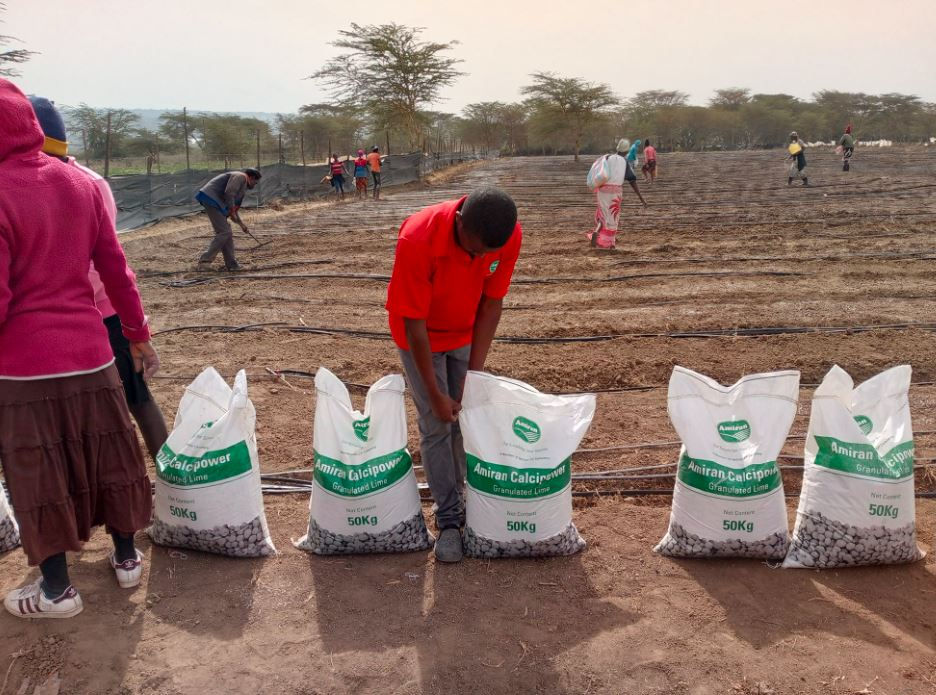
People work in a field with rows of bags labeled "Amiran Calcipower 50kg by Geoffrey Kavita aTop Kenyan Agronomist
Balanced fertilization is essential for high onion yields. At planting, apply DAP (100–150 kg/acre) or well-composted manure to promote strong root establishment. Top-dress with CAN or Urea at 3–4 weeks after transplanting to encourage healthy leaf growth. During bulb formation, apply NPK 17:17:17 or sulfur-rich fertilizers to boost bulb size and quality. Avoid excessive nitrogen after 6 weeks, as it delays maturity and reduces storability. Incorporate micronutrients like boron and zinc if deficient. Regularly monitor soil fertility and adjust fertilizer rates based on soil tests to avoid wastage and environmental damage.
Pest & Disease Management in Onion farming
Effective pest and disease control is crucial for healthy onion production. Thrips are the most common pest, causing silvery streaks on leaves and reduced bulb size — manage them with insecticides or neem-based sprays. Cutworms and onion maggots can damage seedlings and bulbs; apply recommended soil treatments and maintain field hygiene. Key diseases include purple blotch, downy mildew, and fusarium basal rot, which thrive in wet conditions — use crop rotation, proper spacing, and fungicides like Mancozeb to control them. Remove infected plants promptly and avoid overhead irrigation to minimize disease spread.
Irrigation & Water Management in Onion Farming
Onions require consistent moisture throughout their growth cycle for uniform bulb formation. Irrigate lightly but frequently during germination and seedling stages to keep the soil moist but not waterlogged. After transplanting, water every 3–4 days for the first two weeks to help seedlings establish, then shift to weekly irrigation depending on rainfall.

Image of a man walks on a farm with drip irrigation by by Geoffrey Kavita a Top Kenyan Agronomist
Drip irrigation is ideal as it conserves water, reduces disease incidence, and delivers moisture directly to the root zone. Reduce watering gradually as bulbs mature to enhance curing and storability. Avoid excessive watering late in the season as it can cause rotting and split bulbs.
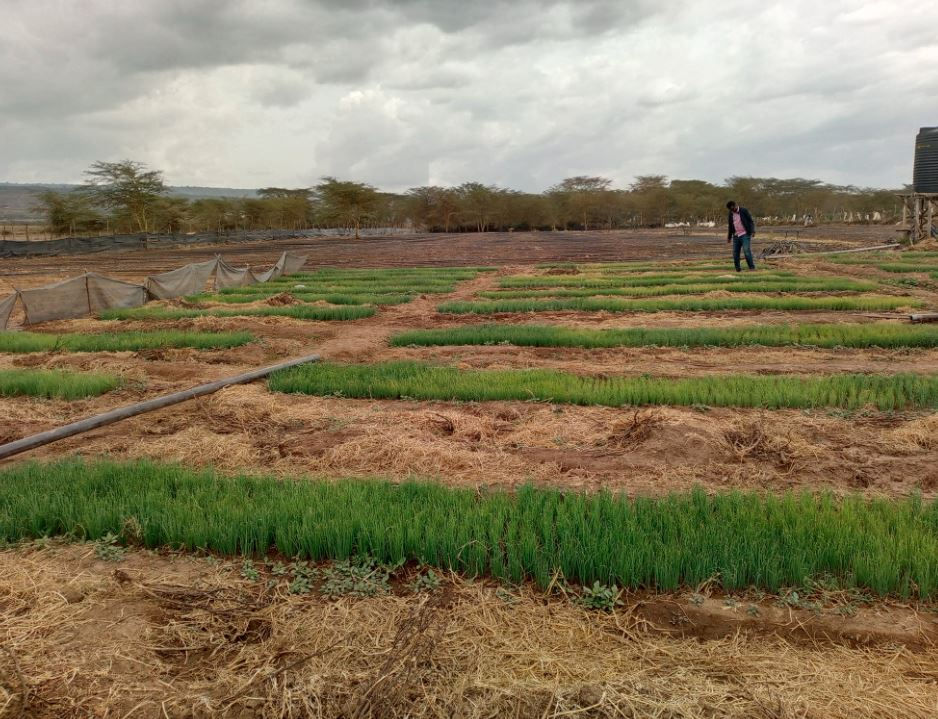
Image of a person walks through a farm with Onion crop rows by Geoffrey Kavita a Top Kenyan Agronomist
Weeding & Crop Management in Onion Farming
Consistent field monitoring and timely pest control ensure healthy growth and maximize yields per acre.
Effective weeding is vital for good bulb development since onions compete poorly with weeds. Carry out the first weeding 2–3 weeks after transplanting and repeat every 3–4 weeks until the crop canopy closes. Use shallow hand hoeing to avoid damaging onion roots. Mulching with dry grass can help suppress weeds, conserve soil moisture, and reduce soil temperature fluctuations. Practice crop rotation with cereals or legumes to minimize pest and disease buildup. Remove any volunteer onion plants or infected crops to prevent disease spread.
bolting is triggered from the roots so you can only prolong the life for a limited time.
Harvesting & Post-Harvest Handling in Onion Farming
Harvest onions when 70–80% of the tops have fallen over and leaves turn yellow-brown, signaling maturity. Loosen the bulbs gently with a hoe or fork and pull them out by hand to avoid bruising. Cure the onions by spreading them in a well-ventilated, shaded area for 10–14 days until the outer skins are dry and necks are tight. Trim roots and tops to about 2–3 cm before storage. Store in mesh bags or ventilated crates in a cool, dry place to prevent sprouting and rotting. Proper post-harvest handling ensures longer shelf life and higher market prices.

Onions are harvested when the tops begin to turn yellow and fall over, indicating that the bulbs are mature. The onions should be lifted carefully to avoid bruising. After harvesting, onions are left in the field to dry for 2-3 days before being stored or transported to the market.
Onions remain one of the most profitable horticultural crops in Kenya, with prices fluctuating based on supply, demand, and imports from Tanzania. As of 2025, wholesale prices range from KSh 60–120 per kg, while retail prices can reach KSh 150–180 per kg in urban markets like Nairobi, Mombasa, and Kisumu. During dry seasons or shortages, prices may spike by 30–50%, offering higher profit margins for farmers who time their planting well.
On average, one acre under good management yields 15–20 tons of bulbs, translating to potential revenue of KSh 900,000 to 2,400,000 per acre depending on market prices. Production costs (seeds, fertilizer, irrigation, and labor) average KSh 200,000–300,000 per acre, leaving a healthy profit margin of over 50%. Profitability can be improved by using hybrid seeds, practicing staggered planting for continuous supply, and selling directly to markets or through contract farming to avoid middlemen.
Onion farmers in Kenya have multiple selling options depending on their production scale. The main wholesale markets include Wakulima Market (Nairobi), Kongowea (Mombasa), and Eldoret Main Market, which attract bulk buyers from across the country. Farmers can also supply directly to hotels, supermarkets, and restaurants, especially if they produce graded onions in bulk. Export opportunities exist through agents for markets like Uganda and South Sudan. For small-scale farmers, selling at farm-gate prices to local traders or through online platforms like Jiji and social media groups can ensure faster cash flow and reduced transport costs.
Price fluctuations are common due to imports from Tanzania and seasonal oversupply, which can drastically reduce profits.
Pests and diseases like thrips, downy mildew, and purple blotch can wipe out entire crops if not managed early.
High input costs for hybrid seeds, fertilizers, and pesticides often discourage small-scale farmers.
Inadequate irrigation infrastructure makes dry-season production difficult,
Poor post-harvest handling leads to storage losses.
Farmers also face exploitative middlemen and limited access to reliable markets.
Market Fluctuations

The price of onions can vary significantly depending on the season. The price fluctuation is mainly attributed to the importation of onions from Tanzania, where the cost production is lower. During the harvest period, prices may drop due to oversupply, while during off-seasons, prices may spike, making it difficult for farmers to predict their income.
High Input Costs
Fertilizers, pesticides, and irrigation systems can be expensive, and this can limit profitability, especially for small-scale farmers.
How many onions per acre?
You can grow 150,000–180,000 bulbs per acre with proper spacing (30cm x 8–10cm).
Best time to plant onions in Kenya?
Plant during the dry season (January–March, July–September) for better bulb quality and fewer diseases.
How long do onions take to mature?
Onions take 90–150 days from transplanting, depending on the variety.
Average yield per acre?
Well-managed farms yield 15–20 tons per acre.

This condition is known as bolting (flowering/seed production) due to some sort of stress. It could be extreme temperature fluctuation. the stress can be from anything that causes the plant to think it's dying and it goes into reproduction as a self preservation mechanism.
Kieni (Nyeri County) leads in production, followed by Narok, Meru, and Kitui.
How much does 1 acre of onions make?
At current prices, farmers can make KSh 900,000–2,400,000 per acre.
Which is the best month to plant onions in Kenya?
January, February, and July are ideal months to start planting.
How much does it cost to farm onions in Kenya?
Production costs average KSh 200,000–300,000 per acre, including seeds, fertilizer, irrigation, and labor.
How many months do onions take to mature?
Onions mature in 3–5 months after transplanting.

According to Simlaw Seeds Onion Variety such as the Gobit F1 takes approximately 2 months to mature after transplanting
What is the best fertilizer for onions in Kenya?
Use DAP at planting, then CAN or Urea for top-dressing, and NPK or sulfur-based fertilizers during bulb formation.
It is highly profitable with 50–70% net profit margins when well-managed.
How much is 1kg of onions in Kenya today?
Wholesale prices range KSh 60–120 per kg, retailing at KSh 150–180 per kg in major towns.


Comments